
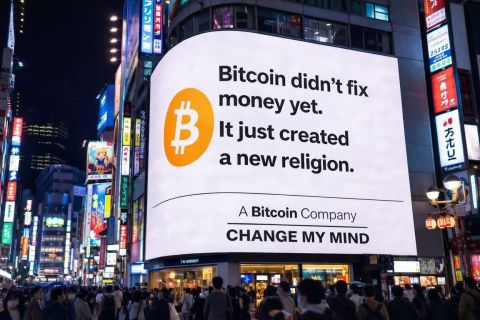
Bitcoin did not fix money yet. In many ways, it created a new religion around price, identity and belief. But the original problem was much deeper than price.
In the late 1990s and early 2000s, cypherpunks and science fiction thinkers saw something most people were not talking about: digital systems do not default to freedom. They default to centralization.
Not because people are always evil. Because coordination scales more easily than consent. When millions of people need to coordinate, systems introduce intermediaries. Intermediaries require trust. Trust concentrates power. Power seeks permanence.
This is not pessimism. It is pattern recognition.
The human chokepoint kept returning.
For roughly two decades before Bitcoin, people tried to build digital money without the same structural flaw. DigiCash failed because it needed a trusted authority. B-money could not solve double-spending without a referee. Bit Gold could not prevent centralization from creeping back in.
Every attempt reintroduced the same bug: a human chokepoint. Someone could decide. And once someone can decide, eventually someone will.
- DigiCash. Brilliant cryptography, but still dependent on a trusted authority.
- B-money. A powerful idea, but unable to remove the need for a coordination referee.
- Bit Gold. A key precursor, but still vulnerable to centralization pressure.
Satoshi solved it with better mathematics, not better democracy.
In 2008, Satoshi did not ask: who should we trust? Bitcoin asked a more radical question: what assumptions are we forced to trust at all?
No CEO to pressure. No central server to shut down. No board to lobby. No terms to negotiate. Bitcoin was not mainly about replacing banks. It was about testing whether coordination requires authority in the first place.
It showed that trust can become optional, consensus can emerge without someone in charge, and resilient systems can be built for adversarial environments.
The early builders were not optimists building utopia. They were pessimists who assumed that power corrupts. That assumption is exactly what made the system resilient.
Then the original question got lost.
Somewhere along the way, Bitcoin became mostly about price. Number go up. When moon. Market cycles replaced the deeper question.
In a world where surveillance is the default and every transaction increasingly requires permission, can freedom be a protocol instead of a privilege?
Bitcoin succeeded the same way encryption did. Not by asking permission. By working. By spreading quietly. By becoming useful. Then by becoming too late to stop.
The next decade is permission versus protocols.
Twenty-five years later, the important question is not only Bitcoin versus the dollar. The real conflict is permission versus protocols. Systems that require approval to exist will compete with systems that can exist because their rules are open, verifiable and difficult to capture.
This is not religion. It is engineering for adversarial environments. But if Bitcoin is going to truly fix money, the industry has to move beyond belief and price. It has to build real-world use cases, real-world assets and stablecoins on-chain where they reduce friction in daily economic life.
So what is the alternative?
If democracy needs permission systems to scale, and permission systems concentrate power, the alternative has to be protocols that limit the amount of permission required in the first place.
That does not remove politics, law or governance. It changes the base layer. It makes abuse harder. It reduces chokepoints. It gives builders a place to coordinate without asking a gatekeeper for every move.
That is the real Bitcoin question. Not whether the chart goes up next quarter, but whether freedom can become infrastructure.