
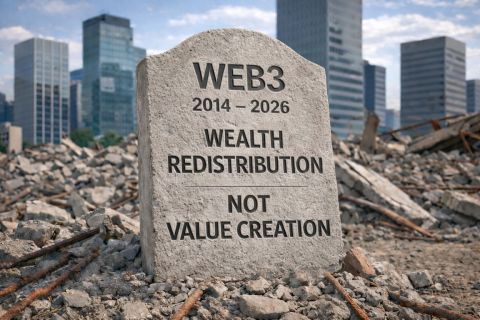
Web3 has had more than a decade and still has no true mass product. The most profitable business category around it is often not infrastructure, software or user adoption. It is marketing.
From a macroeconomic perspective, Web3 has largely produced wealth redistribution instead of real value creation. Its measurable benefits are mostly limited to payments. At the same time, energy use, fraud and the misallocation of capital and labor create significant social costs.
Web3 only becomes net positive when it moves from token speculation toward real economic infrastructure.
A positive welfare balance will only emerge if Web3 moves away from a financially driven token economy and toward systems that reduce transaction, coordination and control costs outside finance.
- Digital identity. People need portable identity that is not locked inside platforms.
- Real-world settlement. Digital rails must settle value in actual economic contexts.
- Non-speculative applications. The product has to be useful even when nobody talks about the token price.
What 250 days of travel taught me about Web3.
Travel is fatal to prejudice, bigotry and narrow-mindedness. Mark Twain understood something every builder eventually learns on the road: nothing is exactly the way it seems from far away.
Travel is disruption. Every day you wake up, the environment changes. Unnecessary weight slows you down. You learn to travel light, move in small teams and reduce coordination overhead.
That lesson applies directly to Web3. Most projects do not fail because the idea is bad. They fail because they overpack. They carry too much infrastructure, too much token logic, too much governance theater, too much marketing and too little necessity.
Why most blockchain projects should not be on-chain.
Build on-chain only if you must. Without clear necessity, blockchain does not create leverage. It creates drag.
Unnecessary complexity kills progress. A project that could work with a database, an API, a contract and a payment flow should not pretend that every workflow needs a token, a chain, a wallet and a governance layer.
Do not use it because it sounds advanced, because investors expect it or because the market rewards narrative density.
For founders, the rule is simple.
Do not follow Web3 marketing hype. Do not use blockchain because it sounds cutting-edge. Use it where it truly fits.
If the problem is custody, provenance, settlement, interoperability, permissionless access, proof or resistance to platform capture, then blockchain infrastructure may create real leverage. If not, it is probably extra luggage.
Rethinking Web3 from first principles.
The next step is to rethink the infrastructure. That is where Web5 begins: not as a buzzword, but as a discipline for building user-owned identity, user-owned data, open protocols and minimal trust assumptions.
Economic design
- No native token dependency as a default.
- Utility before speculation.
- Real usage before financial narrative.
Ownership and control
- User-owned identity without platform logins or identity lock-in.
- Identity-native design, not wallet-native design.
- User-owned data treated as private property, not platform fuel.
- Clear data ownership and custody from the beginning.
Architecture and governance
- Protocols over platforms.
- Open rules over closed companies.
- Separation of data and applications.
- Interoperability by default.
- Permissionless access where it reduces control costs.
- Minimal trust assumptions and fewer intermediaries.
System execution
- Local-first operation with global sync.
- Off-chain business logic where heavy workflows belong.
- Zero-knowledge proof verification where privacy matters.
- On-chain minimalism for settlement and proofs only.
- Reduced storage and execution load.
Build light. Build with intent.
Web2 succeeded because it systematically reduced search, transaction and coordination costs across the economy. Web3 will not win by adding complexity. It will win only where it removes friction that Web2 cannot remove.
The discipline is simple. Travel light. Keep the team small. Reduce coordination overhead. Put only what must be on-chain on-chain. Build the rest where it belongs.
That is how Web3 stops being a token economy and starts becoming real economic infrastructure.