
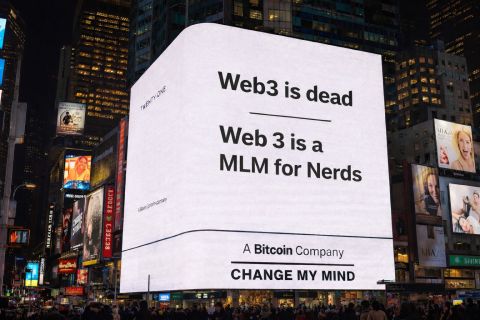
If you spend time outside LinkedIn or Crypto Twitter, especially in the Bitcoin pleb scene, you know the reaction. The moment someone says Web3, crypto, DAO or tokenization, the conversation often ends before it starts.
For many people outside the industry bubble, Web3 means scam. Tokenization means rip-off. DAO means irresponsibility. NFTs mean cringe. Community means a marketing lie.
And the uncomfortable part is this: a lot of that reaction is earned. Web3 did burn itself. It was useless far too often, loud far too often and greedy far too often.
Most people do not hate Web3 because of the technology. They hate Web3 because of the culture.
Web3 became centralized Web2 with useless tokens on top.
Thousands of projects solved nothing real. Community became an excuse for missing business. Worthless utility tokens became a substitute for a product. Decentralization became public relations while the real levers stayed centralized.
That is why the cultural reaction is so strong. The promise was ownership, open coordination and direct value exchange. The reality was often speculation, insider access, governance theater and marketing vocabulary.
- Too loud. The industry talked more than it delivered.
- Too greedy. Token launches became extraction events instead of product milestones.
- Too shallow. Many projects created narratives, but not enough real value.
- Too centralized. The front end, treasury, governance and user relationship often stayed under insider control.
The original Web3 promise was simpler.
If we are honest, Web3 was originally about three things: cutting out middlemen, giving people real ownership of identity and data, and enabling direct payments without a platform gatekeeper.
That was the dream. Web3 turned too much of it into tokenomics, staking mechanics, governance theater, airdrops as marketing budget and frustration for normal people.
The platform logic stayed. The concentration of power stayed. The dependencies stayed. The user did not become meaningfully sovereign.
This is not because normal people are too dumb for decentralization.
It is because Web3 failed culturally. The industry made decentralization feel like a trick, not a protection. It turned ownership into speculation. It turned community into distribution. It turned protocol language into investor theater.
That is why the correction cannot be another buzzword. It has to redraw the line properly.
Web5 is a correction, not a slogan.
Web2 showed how to build products people actually use. Web3 wanted ownership, but buried it under speculation. Web5 should keep the product discipline of Web2 and combine it with the ownership goals Web3 failed to deliver.
The correction has to reject platform identity, worthless forced-entry tokens, governance theater and trust-us promises. Trust should come from architecture, not authority.
- Your identity belongs to you.
- Your data lives with you.
- Payments run directly with minimal friction.
- The platform is replaceable.
- The protocol remains open.
The future is still bold if the culture changes.
Web5 is still growing, but the direction is important. As more people demand privacy, control and portability online, a user-centric model can become the next standard.
Developers are already building tools and applications around Bitcoin, Nostr, decentralized identity and user-owned data. The difference must be discipline. No useless tokens. No empty decentralization. No community theater.
Web3 failed culturally because it confused speculation with ownership. The next stage has to prove that ownership can be useful before it becomes financial.