
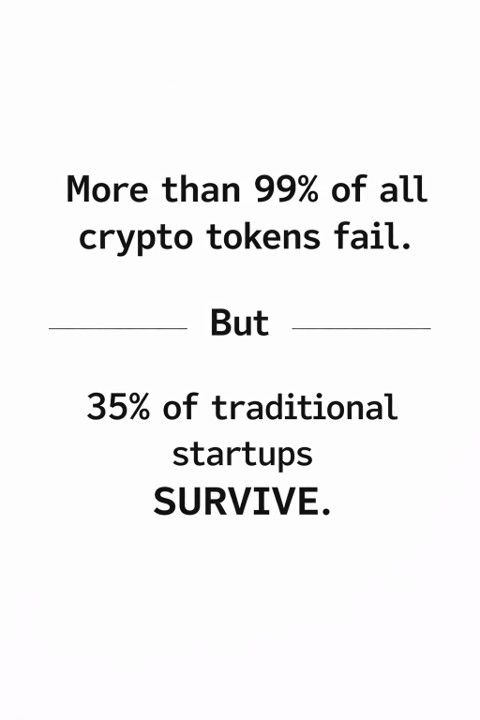
A large-scale dataset covering the 2016 to 2025 token era points to a brutal reality: only around one percent of Ethereum tokens ever exceed 10,000 transfer events. In other words, roughly 99% never reach even a basic activity threshold.
Compare that with traditional startups founded in 2016. Around 35% still exist, and around 20% are profitable. The contrast matters because it reveals the core Web3 problem: the industry has been very good at launching financial objects, but very weak at building companies that people actually need.
Web3 has not created broad macroeconomic value yet. It has mostly redistributed wealth inside speculative markets.
That is the uncomfortable part. Most Web3 startups have not achieved real product-market fit. Many tokens outlive the product narrative for a short time, then disappear once attention, incentives and liquidity dry up.
The pattern is painfully consistent.
Most failing teams begin with a solution in search of a problem. It has to be blockchain. It has to be a token. It has to sound innovative. That is one of the oldest mistakes in the startup playbook, only wrapped in new language.
More than 90% of zombie tokens are unlikely to survive longer than three years. More than 99% do not make it to a decade. In 2025 alone, the market recorded millions of token failures. The exact numbers can move, but the direction is clear.
- Fake traction. Many projects launch with followers, campaigns and airdrops before they have real customers.
- No revenue model. The product is weak, the buyer is unclear and the token becomes the financial distraction.
- Bad incentive design. Large airdrops attract people who dump and leave instead of users who build demand.
- Weak liquidity structure. Poor market-maker terms can turn a launch into a liquidity extraction event.
- Insider pressure. Early allocations at token generation often create a player-versus-player market with the community.
When launching the token becomes the business model.
Founders often believe that if they build something innovative, users will magically arrive. They do not. Instead of validating demand early, many teams take the easier path.
They skip real user demand. They skip product quality. They skip revenue. Then they jump straight to token launch, build a half-finished product, grow a large community with almost no buyers and announce a token because the community supposedly wants it.
After that come marketing agencies, launchpads, market makers and insiders. Everyone is paid to create the impression of momentum. The startup becomes a facade. The product becomes a prop. The token itself becomes the business model.
Marketing agencies, launchpads and market makers can make money even when the underlying project never becomes a real business.
Real product-market fit does not need to be forced.
When product-market fit is real, growth feels different. Awareness increases through word of mouth. Users pull the product into their lives. Revenue appears because the product solves a meaningful problem.
A token, if it exists at all, should be a consequence of that value. It should not be a shortcut around it. Tokens can coordinate rights, access, settlement, ownership or governance, but they cannot substitute for demand.
What Web3 actually needs.
Web3 does not need more abstract narratives. It needs the same fundamentals every real company needs, with better infrastructure underneath.
- Real use cases that solve expensive problems.
- Real founders who understand customers, not only token markets.
- Real companies with revenue, accountability and operations.
- Real buyers who pay because the product reduces pain.
- Real money connected to real activity, not only speculative rotation.
The inevitable truth.
Pure utility-token models have proven to be neither broadly market-viable nor structurally sustainable. Web3 will only become successful once the industry accepts that there are no sustainably successful utility tokens without a real economic base underneath.
Until then, the outcome will stay the same. The pump-and-dump cycle will continue. The wealth redistribution machine will keep moving. And most projects will remain financial theater instead of companies.
The way out is simple, but not easy: build the business first. Let the token, if needed, serve the business later.