
Nostr vs Bluesky
Nostr and Bluesky both talk about open social networking, but Nostr leans on public keys, relays and signed events while Bluesky's AT Protocol uses PDSes, relays, AppViews, DIDs and lexicons.
Why people compare them
Nostr and Bluesky are compared because both are answers to platform fatigue. Both speak the language of open social networking. Both want users and developers to have more room than a closed platform allows. But the architectures are not close twins.
Bluesky is the largest application built on the AT Protocol. ATProto has Personal Data Servers, relays, AppViews, DIDs and lexicons. Nostr has public keys, signed events, relays, clients and NIPs. The comparison becomes useful when you stop asking which one is more decentralized in the abstract and start asking where identity, storage, indexing and product experience sit.
Bluesky in one page
The official AT Protocol overview describes three core services: Personal Data Servers, Relays and AppViews. A PDS hosts a user's data repository and account machinery. Relays crawl and aggregate data across the network. AppViews serve application-specific experiences, such as Bluesky's social app. Lexicons define schemas for records and APIs. DIDs support identity.
That architecture aims to make a large-scale social app feel familiar while opening parts of the stack. It gives Bluesky a polished mainstream product surface and a protocol story underneath. The user experience can be smoother than Nostr because more of the path is productized.
Nostr in one page
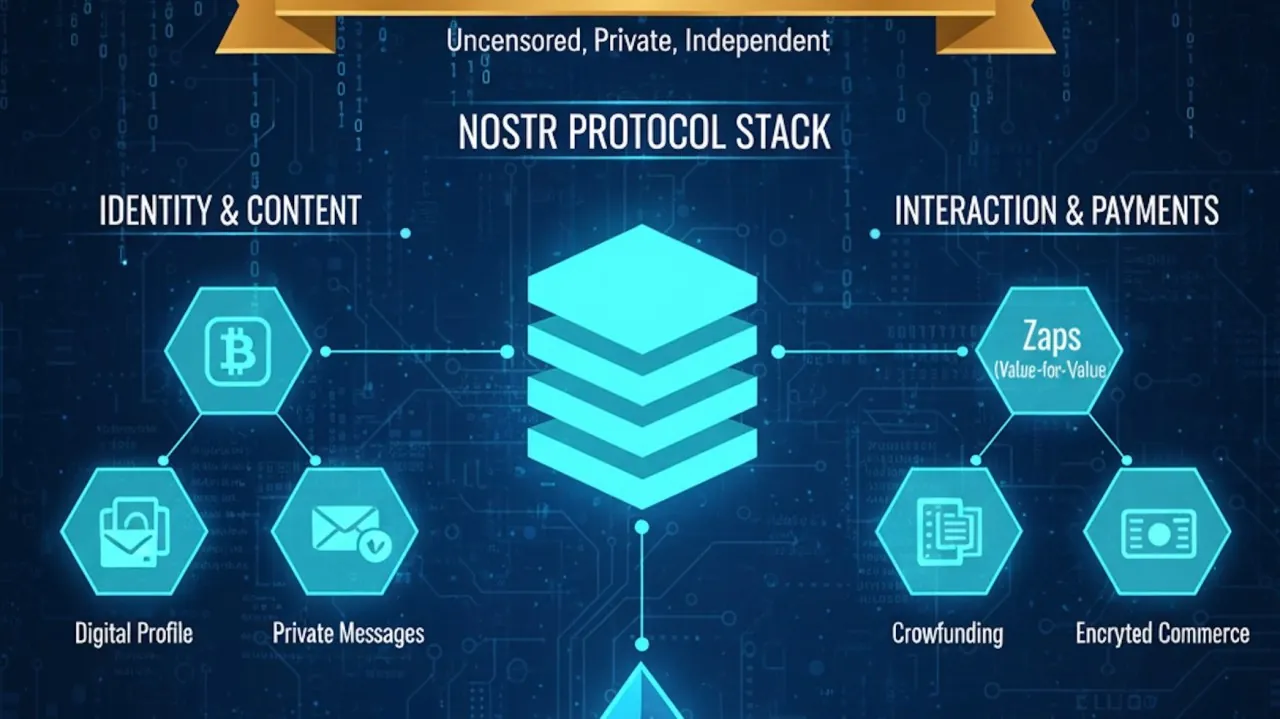
Nostr is smaller and rougher. A user has a key pair. Clients publish and request signed events from relays. Relays do not need to be global crawlers. Clients can be simple, specialized or experimental. Shared behavior lives in NIPs. The public key sits at the center of identity.
That makes Nostr easier to implement at the primitive level and harder to make polished at the ecosystem level. Discovery, search, spam control, media storage and key safety become product problems distributed across many apps and services.
Identity and accounts
Bluesky identities use handles and DIDs, with PDSes playing a major account-hosting role. That is more familiar to ordinary users. Nostr identities use public keys, often represented as npubs, with NIP-05 identifiers available for human-readable domain recognition.
The Nostr model is more radical because the key is the anchor. The Bluesky model is more product-shaped because account hosting and app experience are more coordinated. Neither choice is free. Nostr makes key custody hard. Bluesky makes infrastructure roles more specialized.
Data and indexing
ATProto relays aggregate network data for AppViews. This supports large application experiences, feeds and indexing. It also makes the relay/AppView architecture more central to the visible product. Running large relays is not the same thing as running a small hobby relay.
Nostr relays can be simpler and more numerous, but clients have to find the right data. There is no one global index guaranteed by the base protocol. Search and discovery become competitive product layers. This is why Nostr can feel both more open and more fragmented.
Apps and views
Bluesky's AppView concept makes application experience a named layer. An AppView understands a lexicon and serves a product. Nostr clients also serve product experiences, but they often connect directly to relays and interpret events themselves.
For a reader, the difference is felt in polish and choice. Bluesky can feel like a coherent app first. Nostr can feel like a toolkit that has many apps. One gives a smoother single front door. The other gives more visible protocol edges.
Moderation and control
Bluesky has developed a sophisticated moderation and labeling model around its product and protocol stack. ATProto can support labelers and alternative AppViews. In practice, the flagship app still shapes much of the user experience.
Nostr moderation is scattered across relays, clients, mute lists, labels, web-of-trust tools and community norms. That can avoid one central policy becoming the whole network. It can also make abuse handling feel less predictable. The better model depends on the community and risk.
The reader takeaway
The reader takeaway is simple: Bluesky and Nostr are not two skins on the same architecture. Bluesky is a polished social product on ATProto's PDS/Relay/AppView model. Nostr is a public-key relay protocol where clients and relays compose around signed events.
Choose the comparison question carefully. If you want the smoothest mainstream social app, Bluesky has obvious advantages. If you want portable public-key identity, small protocol primitives, wallet experiments, client diversity and relays anyone can run, Nostr is the more interesting map. The point is not tribal loyalty. The point is knowing which tradeoff you are choosing.
Where Bluesky is stronger
Bluesky is stronger as a polished mainstream social product. The first door is familiar. The app has a clear brand, a large user base, strong default feeds, visible moderation tooling and a product team coordinating the flagship experience. A user does not need to understand PDS, DID, relay, AppView and lexicon before posting.
That matters. Smooth onboarding is not a minor feature. It is the difference between a protocol people admire and a network people use every day. Bluesky's architecture gives it room for openness while keeping the ordinary app experience coherent.
For many users, that coherence is the product. They want a better social app, not a visible protocol lesson. Bluesky serves that desire well.
Where Nostr is stronger
Nostr is stronger when the user or builder wants the protocol edge closer to the surface. A public key can be used across clients without a PDS account model. Relays can be small, specialized or personal. Wallet and Lightning experiments can live beside social events. A client can be a tiny tool rather than a full AppView-shaped service.
This makes Nostr appealing to builders who want simple primitives and fewer platform-shaped dependencies. It also makes Nostr rougher. The user may have to understand keys earlier. The client may have to do more discovery work. The ecosystem may have many overlapping experiments instead of one polished default.
The trade is clear: Bluesky hides more complexity to give a smoother product; Nostr exposes more primitives to give builders and users more direct control.
Why the relay word confuses people
Both ecosystems use the word relay, but not in the same way. In AT Protocol, relays aggregate data from many PDSes and feed AppViews. In Nostr, relays are WebSocket servers that clients publish to and query directly. The same English word points to different architecture roles.
This is a common source of shallow comparisons. A Bluesky relay is not a Nostr relay with a different logo. It sits in a larger PDS/AppView architecture. A Nostr relay is closer to a simple event transport and storage node with policy choices. The operational scale and product relationship differ.
When reading any comparison, replace the word relay with the role it plays. Aggregator for AppViews in ATProto. Event server for clients in Nostr. That one substitution clears up a surprising amount.
What a builder learns from both
A builder can learn from both systems. Bluesky shows the value of coordinated product experience, schema discipline and serious moderation design. Nostr shows the value of small primitives, user-held keys, replaceable clients, wallet-native experiments and permissionless relay operation.
The interesting future may not be one protocol winning every use case. It may be a social web where different identity and data architectures serve different communities. Some users will prefer a polished app with protocol portability behind it. Others will prefer a visible key-and-relay model they can inspect and extend.
The Crays Basics job is to keep those differences legible. Nostr is not Bluesky with more Bitcoin energy. Bluesky is not Nostr with better UX. They are different answers to platform control.
Account recovery and user expectations
Bluesky feels closer to mainstream account expectations. Users think in handles, apps, accounts and recovery flows. ATProto has deeper identity machinery underneath, but the flagship experience can hide most of it. That makes onboarding and recovery feel normal.
Nostr asks the key question earlier. If the user controls the key, recovery is not the same as resetting a platform password. Signers, encrypted backups and better custody tools can help, but the culture has to be honest about the risk. A user who loses a private key may lose control of that identity.
This is one of the real advantages Bluesky has for ordinary users today and one of the hardest Nostr product problems. Nostr can answer it only with excellent signer design, backups, education and recovery patterns that do not betray the key model.
Feed quality and discovery
Bluesky has strong default discovery because the flagship app and AppView can coordinate ranking, feeds, labels and social context at large scale. Users arrive and see a product. They do not have to assemble the network from relays, follows and client choices on day one.
Nostr discovery is more open and more uneven. It can use follows, relays, directories, search, web-of-trust, zaps, lists, labels and client-specific ranking. That gives many actors room to build discovery, but it also makes the beginner path less consistent.
The fair reading is simple: Bluesky is better at the default social app experience. Nostr is better at letting discovery become a competitive, inspectable layer rather than a single product truth.
Developer stack and data shape
ATProto gives builders a structured stack with lexicons, repositories, PDSes, relays and AppViews. That structure can make serious applications more coherent, especially when schemas and large-scale indexing matter. It also means builders often work inside a more defined architecture.
Nostr gives builders a smaller base: signed events, relays, clients and NIPs. The data shape is lighter, more flexible and sometimes messier. A builder can move fast, but they may also have to make choices that a more structured stack would standardize earlier.
This difference explains much of the tone around both ecosystems. Bluesky often feels like a coordinated protocol product. Nostr often feels like an open workshop with production tools scattered across the benches.
Why some users will use both
Many users will not choose one protocol forever. They may use Bluesky for mainstream conversation and Nostr for Bitcoin culture, open-source work, zaps, relay experiments, long-form posts or portable identity. That is not hypocrisy. It is normal behavior in a multi-protocol web.
The interesting question is not which app gets moral victory. The interesting question is which identity and publishing model fits each job. A journalist may want reach on Bluesky and a durable public key on Nostr. A developer may want ATProto schemas for one project and Nostr events for another. A creator may use both audiences.
Crays keeps the comparison page because readers need language, not tribal slogans. The architectures differ. The product experiences differ. The right choice depends on the job the reader is trying to do.
Why ATProto feels more product-shaped
ATProto often feels more product-shaped because its flagship social app and protocol story developed together. Personal Data Servers, relays, AppViews, lexicons and DIDs can sit behind an interface that still feels like a normal social network. Most users encounter the app first and the architecture later.
Nostr often works in the opposite direction. The architecture is visible early. Users see npubs, relays, signers, NIP links and wallet features before every product edge is softened. That visibility is exciting for builders and intimidating for beginners.
The difference is not simply polish. It is where each ecosystem chooses to hide or expose complexity. Bluesky hides more of the machinery behind a coordinated product. Nostr exposes more of the machinery so independent tools can touch it directly.
Why Nostr feels more workshop-shaped
Nostr feels workshop-shaped because anyone can pick up the primitives and build something small. A relay can be specialized. A client can be experimental. A bot can publish events. A signer can solve one custody problem. A wallet integration can attach payments to social actions. The barrier to trying ideas is low.
That workshop energy creates rapid invention and uneven quality. Some tools feel magical. Some feel half finished. Some overlap. Some disappear. For an expert community, this is normal. For a beginner, it can feel like disorder. The Basics route exists to turn that disorder into a map.
The workshop shape is not a bug by itself. It is the cost of permissionless experimentation. The challenge is deciding which experiments deserve durable product treatment and which belong in the archive.
Identity comparison in plain language
In plain language, Bluesky makes identity feel like an account with protocol machinery underneath. Nostr makes identity feel like a public key that apps learn to use. Both can support handles and migration stories, but the everyday mental model differs.
A Bluesky user can mostly think in app terms. A Nostr user benefits from understanding key terms earlier. That is why the same person may find Bluesky friendlier on day one and Nostr more interesting on day thirty. Familiarity and control arrive in different orders.
This comparison is not a value judgment. It is a reader aid. If a product asks for a private key, the user is in Nostr country. If a product talks about PDSes and AppViews, the user is in ATProto country. Both are open social experiments, but they ask different things of the user.
Moderation and labels
Bluesky has invested heavily in labeling and moderation flows around a mainstream app experience. That gives the user clearer defaults and gives the product team a strong role in how safety feels. Alternative labelers and AppViews can exist, but the flagship app still shapes perception.
Nostr moderation is more distributed. Relays can apply policy, clients can filter, users can carry mute lists, labelers can publish signals and web-of-trust tools can rank. This gives more pluralism and more confusion. The user may need to know which layer made something disappear or appear.
The reader should ask a practical question: who do I trust to make safety decisions for this context? In Bluesky, many users trust the app defaults. In Nostr, trust may be split across client, relay, community and personal lists.
What each side still has to prove
Bluesky still has to prove that protocol openness becomes meaningful beyond the flagship product. If most users, developers and social energy remain centered on one app, the architecture may be open in theory but less plural in practice. The ecosystem has to show that independent services can matter.
Nostr still has to prove that visible control can become humane. Key custody, discovery, moderation, private messaging, media, spam and wallet permissions need products that feel trustworthy to people who are not protocol hobbyists. The primitives are promising, but the user experience has to earn confidence.
That is why the comparison stays alive. Both systems are unfinished. Both are serious. Both are trying to loosen the grip of closed social platforms in different ways.
What the reader sees first
The reader sees different things first. On Bluesky, the reader sees a social app with handles, posts, follows, feeds and moderation cues. The protocol architecture is available for people who look deeper, but it is not the first object on the table. On Nostr, the reader often sees the protocol sooner: keys, npubs, relays, signers and NIP links.
That first impression shapes expectations. A Bluesky user may ask whether the app is enjoyable. A Nostr user may ask whether the identity model is worth learning. Both are legitimate questions. A protocol that reaches ordinary people needs both architecture and feeling.
The comparison helps because it stops the reader from judging both systems by one standard. Bluesky leads with product coherence. Nostr leads with primitive openness. Each strength creates its own weakness.
Where data portability is felt
Data portability is felt differently in each ecosystem. In Bluesky, portability is tied to the ATProto account, repository and service architecture. In Nostr, portability is felt when a key can appear across clients and signed events can be found through relays. Both stories involve more detail than a slogan can carry.
For Nostr, the visible test is simple: can the reader use another client without rebuilding identity from zero? Can a note link resolve? Can a profile be verified? Can a relay list help discovery? For Bluesky, the test is whether the account and data model can support meaningful movement beyond the flagship app experience.
These tests are practical. They matter more than abstract claims about openness. The reader should judge by what they can actually move, verify and use.
Why the Bitcoin link changes Nostr
Nostr is not Bitcoin, but the Bitcoin link changes the culture and product surface. Many early users care about self-custody, censorship resistance, Lightning payments, open-source infrastructure and skepticism toward platform control. That culture made zaps and wallet experiments feel natural rather than bolted on.
Bluesky grew from a different social and technical context. Its mainstream appeal, moderation focus and app coherence are part of that story. Comparing the two without noticing culture misses why the same feature can feel different in each place.
For readers, this means Nostr often mixes social networking, money, identity and open-source infrastructure more openly. That mix is powerful and sometimes chaotic. It explains both the energy and the roughness of the ecosystem.
The simple choice frame
The simple choice frame is this: choose Bluesky when the job is a polished public conversation with strong defaults, and choose Nostr when the job is portable key-based identity, wallet-native social actions or a product that needs to work outside one flagship app. Many readers will use both because the jobs are different.
That frame is more useful than ranking the protocols like teams. A good social app, a payment-aware community, a publishing tool, a developer experiment and a mainstream news conversation do not all need the same architecture. The serious reader compares fit, not slogans.