 Enoch Root
 fiatjaf
 William Casarin
 Vitor Pamplona
 PabloF7z
 Hodlbod
 Yuki Kishimoto
 Mike Dilger
 Alex Gleason
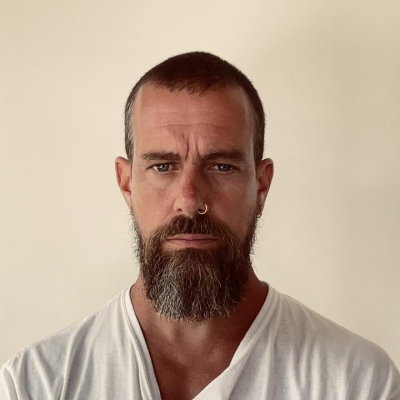 Jack Dorsey
 ODELL
ODELL Ben Arc
 Vanessa
 Terry Yiu
 Derek Ross
 Karnage
 OpenMike
Jack Dorsey
Jack Dorsey did not build Nostr. What he did was drag it into the serious open-social conversation: with money, attention, public-key symbolism, and a very visible break with the platform model he helped create.
The platform founder who ran into the platform problem
Jack Dorsey is not a Nostr developer in the usual sense. He did not write the first NIP, maintain the core repositories or build the clients that early users lived in. His role is stranger and more public. He is one of the people who helped create the platform era, then spent years trying to find a way out of its worst incentives.
That is why he matters here. Dorsey's Nostr story is a biography of reversal: Twitter co-founder, Square and Block founder, Bitcoin advocate, Bluesky backer, then one of the loudest outside supporters of Nostr. The interesting part is not celebrity. The interesting part is that he had already seen what happens when social identity, public conversation and distribution are locked inside a company.
Block's own leadership page still places him in a very corporate world: Block Head, chairman and cofounder. That background is useful because it keeps the story grounded. Dorsey is not an outsider throwing stones at social media. He helped build a global social platform, ran public companies, sat inside the rooms where product choices became governance choices, and came away arguing that the base layer for speech should not be owned by a company.
Twitter made the question personal
Twitter is the unavoidable first chapter. It gave Dorsey his name, his wealth, his public image and a front-row seat to a problem that almost nobody knew how to solve. A service that began as a simple status tool became a global square for journalists, politicians, artists, traders, activists, founders, trolls, fans and ordinary people who just wanted to know what was happening.
The more important Twitter became, the less it looked like a normal app. Moderation choices became political events. API changes could break whole businesses. Algorithm decisions changed whose voice carried and whose disappeared. A username became a piece of public identity. A ban could feel like exile from the town square. That is the background behind Dorsey's later obsession with protocols.
His critique of Twitter can sound too neat. It is easier to say, years later, that Twitter should have been a protocol than to explain every decision made while it was a company. Still, the critique lands because Twitter proved the problem in public. A company can build a beautiful social product and still become the gatekeeper for speech, identity, discovery and developer access.
Bluesky was the first answer
In December 2019, Dorsey announced that Twitter would fund a small independent team to work on an open decentralized standard for social media. That project became Bluesky. At the time, the idea was genuinely bold: Twitter might one day become a client of a protocol instead of the owner of the whole social graph.
Bluesky did become real. It developed AT Protocol, spun out from Twitter, built a social app and brought a large mainstream audience into a more protocol-aware conversation. That should not be dismissed. For many people, Bluesky was the first time the words decentralized social media felt less like an academic paper and more like a usable app.
But Bluesky also became the point where Dorsey's patience with company-shaped decentralization seemed to run out. It had a board, investors, a public benefit corporation, a flagship app, moderation fights and the same gravitational pull that every successful social product develops. From Dorsey's point of view, that looked too familiar. It was not Twitter, but it was close enough to make him uncomfortable.
Block, Bitcoin and the open-protocol habit
Square, later Block, is the other half of the biography. Dorsey co-founded the payments company after Twitter had already made him a public tech figure, and Block gave him a different kind of problem to work on: money moving through everyday life. Small sellers, card readers, Cash App, Bitcoin, payroll, banking features and merchant tools are not as culturally loud as Twitter, but they sit closer to the question of who gets access to the financial system.
That is where his Bitcoin language comes from. In a 2026 WIRED interview, Dorsey framed Bitcoin as an open protocol for money transmission and said he did not want customers to move from one gatekeeper to another. That sentence is important because it explains why Nostr made sense to him. He was already thinking in pairs: open money, open social identity; Bitcoin for value, Nostr for speech and presence.
Dorsey also has a public operating style that fits this pattern. He is not the polished conference-suite version of a CEO. WIRED described the nomadic lifestyle, the meditation habit, the beard, the attraction to open source, Bitcoin, decentralization and new technical shifts. Some of that can sound like founder theater. Some of it is just a consistent temperament: he gets drawn to systems that promise fewer middlemen, faster feedback and less permission from the old stack.
That temperament can be brutal too. His 2026 defense of major Block layoffs was built around the idea that AI would change how companies are structured. Whether that argument convinces you is separate from the Nostr story, but it shows the same reflex: he sees a technological shift, decides the old organization is too heavy, and tries to rebuild around the new layer before everyone else is comfortable. In social media, that new layer is protocol.
That is also why his career keeps looping back to infrastructure rather than pure content. Twitter was not valuable because Dorsey had the best posts. Square was not valuable because he loved receipts. Block, Bitcoin, Bluesky and Nostr all sit around rails: who can publish, who can pay, who can identify themselves, who gets blocked at the edge and who has a route around the gate.
Why Nostr felt different
Nostr gave Dorsey a rougher, less polished answer. It did not arrive with a foundation, a CEO, a main app or a clean growth story. It was closer to a set of simple primitives: keys, signed events, relays and clients. That made it awkward for normal users, but attractive to people who cared about the base layer.
For someone coming out of Twitter, the difference is obvious. In Nostr, identity starts with a key, not an account granted by a company. Clients can compete on interface without owning the user's identity. Relays can appear, disappear, specialize or block content without becoming the whole network. The result is messier than a platform, but the user is not trapped in the same way.
That does not make Nostr magic. It has spam problems, discovery problems, user-experience problems and a culture that can be hard for outsiders to read. Dorsey's bet was not that Nostr already felt better than mainstream social media. His bet was that its structure left more room for freedom, experimentation and exit.
The 14 BTC post
The moment Nostr became impossible to ignore in Bitcoin circles was short and very Dorsey: 14 BTC deployed to fiatjaf for Nostr. CoinDesk reported the donation in December 2022, noting that the amount was worth roughly $245,000 at the time and went to fiatjaf, the pseudonymous creator most associated with Nostr's origin.
That one transfer changed the temperature around the protocol. Nostr had already existed, and the builders doing the work did not suddenly appear because a famous founder noticed them. But money and attention change what a scene can do. Developers could point to the donation as proof that serious people were watching. Bitcoin users had a reason to try the strange new clients. Journalists had a clean story: a Twitter co-founder was funding a protocol that tried not to become Twitter.
It also created a confusion that still needs correcting. Dorsey did not buy Nostr. He did not appoint himself its leader. He did not turn it into a company. What he did was use his money and reputation to make the protocol much more visible. In a young open-source network, that kind of visibility can be a gift and a distortion at the same time.
OpenSats made the funding less personal
After the direct fiatjaf donation came the more durable funding path. In 2023, OpenSats announced a $10 million #startsmall donation for free and open-source work around Bitcoin, Nostr and related projects. In 2024, OpenSats announced another $21 million from #startsmall, including $5 million for the Nostr Fund.
This part of the story is less dramatic than 14 BTC in a public post, but it matters more for the people building. Open-source work needs maintenance, design, documentation, security review, mobile polish, relay operations, libraries and boring follow-through. Grants do not solve all of that, but they give serious builders time.
OpenSats also changed the shape of Dorsey's influence. Instead of one rich founder directly choosing every recipient, there was a public grant organization with its own process and announcements. That does not remove politics or judgment from funding. It does make the support easier to track and harder to confuse with ownership.
Leaving Bluesky made the split public
The public break with Bluesky became clear in 2024. The Guardian reported that Dorsey had left the Bluesky board, and Business Insider summarized his Pirate Wires explanation: Bluesky, in his view, was repeating too many of Twitter's company mistakes. He wanted to focus on Nostr and on funding open protocol work instead.
The symbolism was blunt. His X bio, at one point, contained only his Nostr public key. To a casual user that looked cryptic. To Nostr people it was the whole point. A public key is ugly, portable and not issued by a platform. It is not a blue check. It is not a company handle. It is the user's anchor.
That move did not make Dorsey a neutral observer. He had started Bluesky, funded it, sat on its board and then publicly cooled on it. But that is what makes the biography interesting. His path is not a clean conversion story. It is a series of attempts to answer the same question: how do you build social media where the user is not renting identity from a company?
andOtherStuff and the workshop phase
By 2025, the story had moved from protocol preference into product experimentation. TechCrunch reported that Dorsey backed andOtherStuff with $10 million. The group included people already known around Nostr and open social work: Evan Henshaw-Plath, Calle, Alex Gleason, Jeff Gardner and Dorsey himself.
The name is a Nostr reference: Notes and Other Stuff Transmitted by Relays. The project list is broader than one client. It reaches into social apps, encrypted messaging, creator tools, Cashu, ActivityPub-adjacent work and experiments like Divine. That is the more interesting Dorsey phase: not only saying protocols are better, but funding people who are trying to make protocol-based products feel usable.
This is also where the limits show. A wealthy founder can speed up useful work, but he can also bend attention toward his taste. Nostr's best defense is that no one should be able to own the whole path. If AOS ships useful tools, great. If it misses, the protocol should still leave room for others to build differently.
The uncomfortable part
A serious Dorsey profile cannot turn the funding trail into a halo. Business Insider's reporting around the fiatjaf donation raised hard questions about direct funding, pseudonymous scenes and what people know or do not know when money moves quickly. That belongs in the biography because it shows the cost of moving through informal networks.
Open-source culture often runs on trust, speed and personal reputation. That can be powerful. It can also be sloppy. Dorsey's Nostr support helped builders and gave the protocol attention, but it also attached his reputation to choices that were not always easy for outsiders to evaluate. The lesson is not that funding should stop. The lesson is that funding needs memory, transparency and criticism.
That tension is part of his role in Nostr. He is useful because he brings money and a giant spotlight. He is risky for the same reason. A protocol that wants to escape platform power has to be honest about softer forms of power: attention, grants, celebrity, access and narrative.
A public figure with a private streak
Dorsey is also hard to write about because he is public and private in an unusual mix. He has been on magazine covers, in congressional hearings, on earnings calls and in the center of global platform fights. At the same time, he often communicates like someone who would rather leave a clue than give a speech: a short post, a public key in a bio, a grant, a terse explanation, a project link. That style works beautifully on Nostr because Nostr culture is full of cryptic handles, short notes and people who prefer working code to polished positioning.
It can also make him easy to mythologize. Supporters see the founder who understands what Twitter should have become. Critics see a billionaire trying to launder platform history through protocol language. Both readings contain something. Dorsey really did help create the company model he now criticizes. He also really did put serious money behind alternatives that do not put him in charge.
The personal details that matter are the ones that connect to the work. The meditation habit matters because it fits his public image of discipline and distance. The remote, wherever-feels-right lifestyle matters because it matches a founder who talks about distributed systems and runs a remote company. His fascination with Bitcoin matters because it gives the Nostr story an economic spine. The childhood trivia does not matter much here. The adult pattern does.
What he is in Nostr, and what he is not
The cleanest description is this: Jack Dorsey is a catalyst in the Nostr ecosystem. He is not the creator, not the maintainer, not the protocol's owner and not the person who should define the culture alone. He is the famous outsider-insider who made a lot of people take the protocol seriously.
His real contributions are concrete. He gave 14 BTC to fiatjaf. His #startsmall money helped fund OpenSats and the Nostr Fund. He left Bluesky's board and publicly chose Nostr as the more interesting protocol direction. He backed andOtherStuff so that open social builders could try actual products, not just argue theory.
His presence also gives Nostr a biographical irony it could never manufacture. One of the people most associated with Twitter now backs a network designed so no new Twitter has to own the user's identity. That does not erase the history of Twitter. It makes the Nostr chapter sharper.
The short version
If you strip the story down, Jack Dorsey matters to Nostr because he connects three worlds that usually talk past each other: mainstream social media, Bitcoin funding culture and open-source protocol work. He knows the platform problem from the inside. He has the money to support alternatives. And he has enough public weight to make people outside the scene ask what Nostr is.
That does not make him the hero of Nostr. The protocol is carried by the people writing code, running relays, designing clients, documenting rough edges, teaching beginners, reporting on releases and using the thing before it is comfortable. Dorsey's role is to make that work harder to ignore.
The best way to read him is with interest and distance. Take the funding seriously. Take the platform critique seriously. Take the criticism seriously too. Jack Dorsey's Nostr biography is not a clean redemption arc. It is the story of a platform founder trying, imperfectly and publicly, to put his weight behind a different kind of social internet.
Sources worth opening
- Block official leadership profilePrimary company source for Dorsey's current Block role: Block Head, chairman and cofounder.
- 2019 Bluesky announcement on XDorsey's original public announcement that Twitter would fund a small independent team to develop an open decentralized social-media standard.
- SiliconANGLE Bluesky beta reportUseful secondary record connecting the 2019 Bluesky plan to AT Protocol and the later product launch path.
- CoinDesk 14 BTC funding reportDirect report on the 14 BTC donation to fiatjaf and the moment Dorsey publicly put money behind Nostr.
- Jack's 14 BTC post on XThe short public post announcing 14 BTC deployed to fiatjaf for Nostr.
- OpenSats 2023 #startsmall funding postOpenSats' own announcement of a $10 million #startsmall donation for Bitcoin, Nostr and related open-source work.
- OpenSats 2024 #startsmall funding postOpenSats' own announcement that $5 million of a $21 million #startsmall donation went to the Nostr Fund.
- OpenSats Nostr FundPrimary page for the Nostr Fund that started in 2023 with a contribution from Dorsey's #startsmall.
- Guardian on the Bluesky exitReporting on Dorsey leaving the Bluesky board, the Nostr public-key symbolism and the $5 million Nostr allocation.
- Business Insider on why he left BlueskyPeter Kafka's summary of Dorsey's Pirate Wires explanation: Bluesky, boards, funding and the turn toward Nostr.
- Pirate Wires interviewThe original interview framing Dorsey's critique of centralized social-media companies and his protocol thesis.
- TechCrunch on andOtherStuffDetailed report on Dorsey's $10 million backing of andOtherStuff, the Nostr-linked team and early projects.
- Engadget on andOtherStuffSecondary coverage with clear quotes around why Dorsey prefers protocol-like openness to another company layer.
- andOtherStuff official sitePrimary project page for AOS, its Nostr-inspired name and the projects it presents as part of the freedom-tech stack.
- TechCrunch on DivineCurrent example of andOtherStuff financing social products rather than only publishing protocol manifestos.
- Business Insider on the fiatjaf controversyCritical reporting around Dorsey's Nostr funding path and the controversy attached to fiatjaf; useful for the influence-without-ownership section.
- WIRED 2026 interview with DorseyRecent profile/interview source for Dorsey's Block role, open-protocol language, Bitcoin framing, Bluesky criticism, lifestyle and operating style.